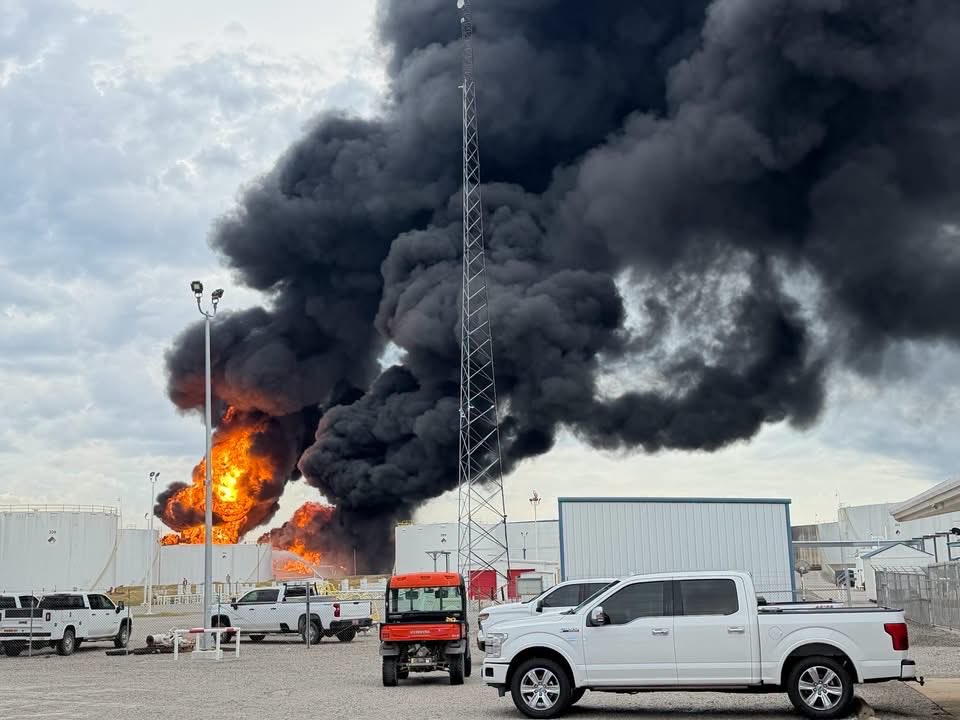
A lightning strike ignited three tanks at the Explorer Pipeline tank farm in Glenpool on Aug. 17, collapsing at least one tank and sending a massive plume of black smoke visible across the Tulsa metro area.
Emergency crews responded just after 8:30 a.m. to the facility near Highway 75 and West 126th Street, according to KFOR. No injuries were reported.
The smoke was visible from inbound flights to Tulsa International Airport, Bloomberg reported. Glenpool Fire Chief Paul Newton called the smoke "extensive" in remarks reported by the Tulsa World on Aug. 17, and said air quality monitors reported nothing of concern as of early Monday afternoon.
The Tulsa Fire Department said on X that residents in the Glenpool area should stay indoors when possible to limit exposure, noting three tanks were reportedly involved.
Evacuations and road closures
Glenpool officials recommended a voluntary evacuation for residents between 126th and 131st streets, from Elwood Avenue to U.S. 75. Evacuees were directed to the Glenpool Church of Christ. Glenpool Public Schools activated shelter-in-place procedures as a precaution.
The Glenpool Police Department closed two intersections: West 126th Street at South Elwood Avenue and West 126th Street at Casper Street.
By late Monday afternoon, evacuated residents were told they could return home, though the fire was still burning at that time.
Explorer Pipeline response
Explorer Pipeline confirmed the lightning strike in a Facebook statement posted Monday. The Tulsa-based company said fire crews had responded and secured the site, with additional resources en route. The company asked the public to stay clear of the area due to road closures.
Explorer Pipeline operates an 1,872-mile system transporting refined petroleum products from Port Arthur, Texas, to the upper Midwest.
History at this site
The last time lightning caused a fire at the same Glenpool tank farm was June 2006, according to the Tulsa World. That blaze took crews 10 to 11 hours to extinguish.
Whether Monday's fire has been fully extinguished has not been confirmed as of Aug. 18. Residents can monitor air quality updates through the Oklahoma Department of Environmental Quality.