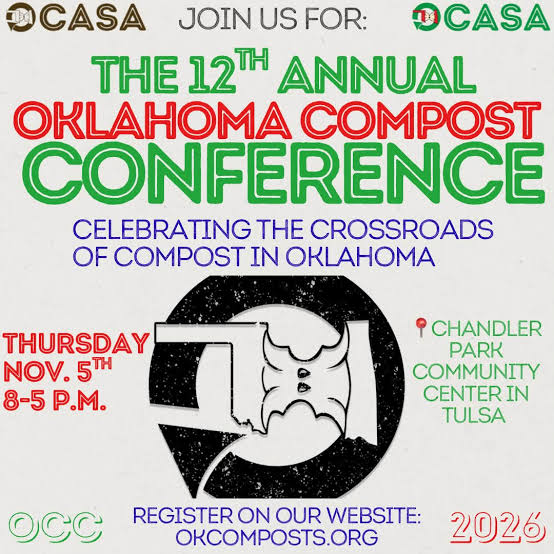
The Oklahoma Compost Conference arrives in Tulsa for the first time Nov. 5, and organizers increased capacity after registration sold out weeks before the event.
The 12th annual event, organized by the Oklahoma Compost and Sustainability Association (OCASA), sold out weeks before the conference. Board president Amanda Scofield told the Tulsa Flyer this is the first time the conference had to increase its attendee limit to meet demand.
The full-day gathering at Chandler Park Community Center features workshops on municipal waste sludge composting, mushroom inoculation and a panel with tribal Environmental Protection Agency managers, the Flyer reported. Local businesses are contributing food, utensils and recycling to run it as a zero-waste event.
Why Tulsa, why now
James Taylor, an OCASA board member and founder of SCRAPS Community Composting, helped bring the conference to town. Taylor told the Tulsa Parks and Recreation Board at its April 14 meeting that SCRAPS operates what he called the first Department of Environmental Quality (DEQ) small-scale composting permit-exempt site in the state, located in The Heights neighborhood.
Ali Kalenak, education outreach manager at the Tulsa-based Metropolitan Environmental Trust, said Tulsa has "traditionally been behind Oklahoma City" in composting, according to the Flyer. OCASA's training and workshops have occurred mostly in Oklahoma City until this year.
Scofield said the group wants to keep expanding statewide. She believes in "spreading the compost gospel across the state and connecting (the) compost community."
A gap in food-waste options
Tulsa's City Mulch Site accepts yard waste such as branches, grass clippings and leaves. Two commercial composters, The Organic Recycler, formerly Gem Dirt, and Organic Recyclers, also handle land waste, the Flyer reported.
But SCRAPS is the only operation in Tulsa that accepts food scraps. The reason is not lack of interest. Until recent years, state rules made it hard for noncommercial operations to get permits.
"The (Department of Environmental Quality) had commercial waste classified in a way where if it came from a commercial kitchen, then it had to go to a commercial permitted composting site," Taylor told the Flyer.
That strict process forced at least one previous operation, Full Sun Composting, to shut down. Tulsa still lacks a commercial food-waste composter.
OCASA successfully pushed the state to create a small-scale permit exemption for operations under 100 tons or 200 cubic yards, Scofield told the Flyer. Under the new rules, small-scale composters can accept food waste from restaurants and commercial kitchens.
What it could mean for trash bills
Citywide food composting could save Tulsa residents money, Kalenak said. Diverting food waste from the trash reduces the processing fee the city pays each year.
"The city has to pay the trash processor every year … to dispose of how much waste we dispose of, so if it can be less, then the city pays less, then (residents') rates don't increase as much," she told the Flyer.
A municipal program would require public support and a large enough facility. Contamination remains a concern. It is the biggest challenge facing the city's recycling program, the Flyer reported.
Nationally, the EPA estimates 66.2 million tons of food was wasted in 2019. Wasted food accounts for 58% of landfill methane emissions, according to the agency.
How Tulsa-area residents can start
Tulsa residents can sign up with SCRAPS for a compost bucket and weekly pickup in downtown and midtown neighborhoods for a suggested $25 monthly donation. In Owasso, GROwasso runs a volunteer drop-off program that feeds community gardens.
OCASA members pay a small fee and receive early registration for events plus a free cubic yard of compost. The group is also looking to fill board and committee vacancies.